
Soil transition model (STM)
What is the STM – short answer
The soil transition model (STM) is a simple map that illustrates how soil management affects crop performance through two dominant, controllable soil functions: water and nutrients.
The horizontal axis represents effective plant‑available water capacity (AWC) – how well soil holds and supplies water to roots.
The vertical axis represents nutrient flux, with nitrogen used explicitly as a proxy for overall nutrient system behaviour.
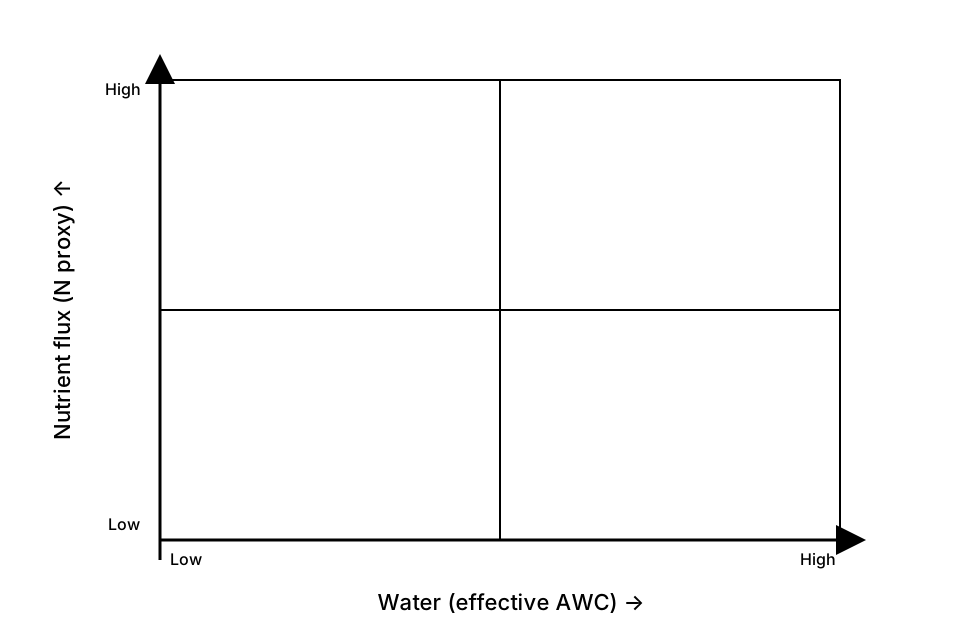
Each zone of the STM shows where different management approaches tend to leave soils:
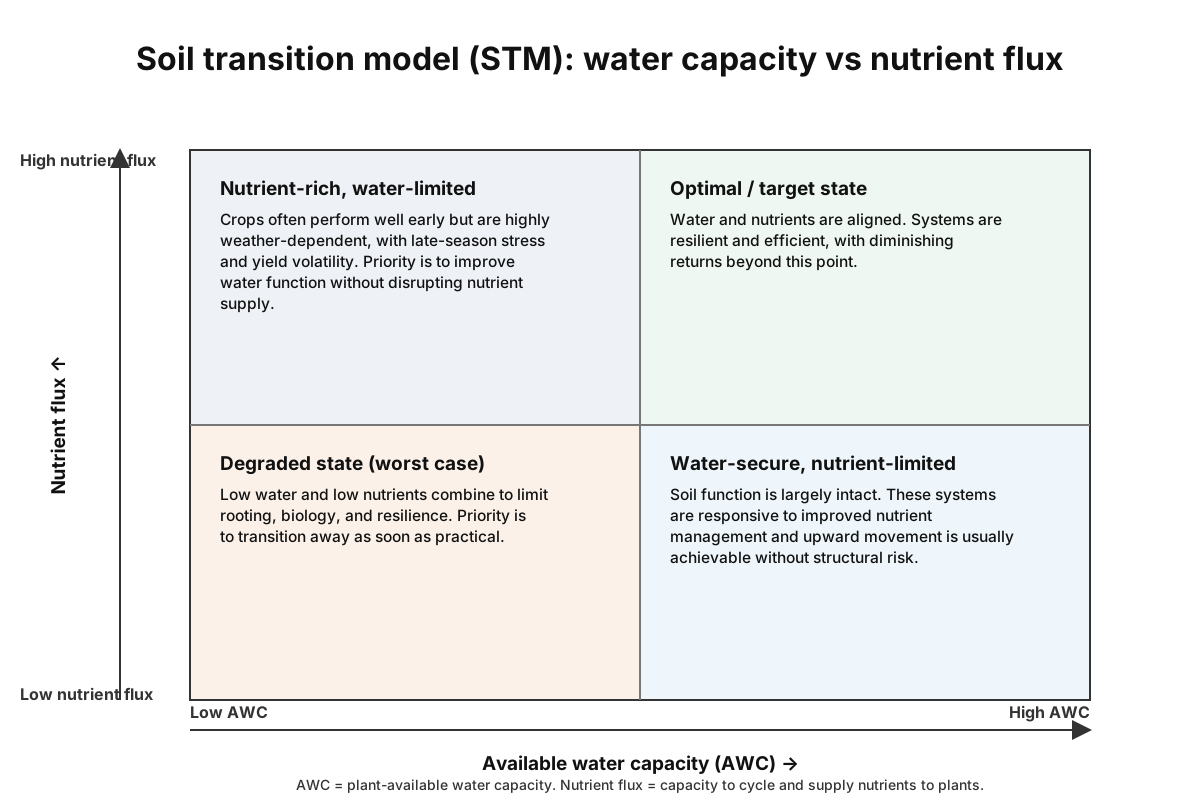
In managed soils, effective AWC is primarily controlled by soil aggregation and pore continuity, which are stabilised over time by humus (MAOM).
Different practices (biology-first, chemistry-first, recycled organics) move soils in different directions on this map. The STM explains why these movements occur and why some systems stall while others transition successfully over time.
1. STM model scope and assumptions
The Soil Transition Model (STM) is a simplified, illustrative framework designed to support diagnosis and communication, not to act as a full mechanistic soil simulator.
It assumes that climate, crop genetics, and soil texture are fixed boundary conditions, and focuses instead on the dominant controllable constraints on growth: effective plant-available water capacity (AWC) and nutrient flux (represented by nitrogen).
Terminology: throughout the STM model, the term humus is used deliberately to denote the physically persistent, microbially stabilised fraction of soil organic matter as defined in the HealthySoil definitions. Within this scope, humus is treated as the primary controllable stabiliser of AWC over multi-year timescales, acting through aggregation and pore architecture. This dominance is relative to other controllable factors, not an absolute claim about all drivers of soil water.
2. The STM flux matrix (core model)
The STM is anchored around two dominant, controllable constraints on plant growth. Climate, crop genetics, and radiation are treated as fixed boundary conditions rather than management levers.
X-axis: effective plant-available water capacity (AWC)
In managed soils, effective AWC is strongly governed by stable soil organic matter (humus), because humus stabilises the aggregate framework and pore architecture that holds and transmits water through the soil profile. In this model, humus is treated as the dominant controllable driver of AWC, not the only factor involved.
Y-axis: nutrient flux (nitrogen as a proxy)
Nitrogen is used deliberately as a proxy for nutrient system behaviour, representing availability, synchrony with crop demand, and retention across the wider nutrient suite.
This matrix is diagnostic, not moral. It shows where soils functionally sit and which constraint is currently limiting performance, rather than prescribing a single management ideology.
How to read the four STM zones
The STM is best read as a diagnostic transition map, not as a set of fixed labels. Each zone represents a functional state that soils may occupy temporarily or persist in, depending on management and history.
The goal is not to maximise both axes indiscriminately, but to identify the current limiting constraint and apply practices that move the system rightward or upward without damaging what is already working well.
The four STM zones
Key management rule
Move right or up, depending on the current constraint.
Avoid interventions that damage the function that is already high (for example, forcing nutrient gains that degrade structure, or building structure while starving crops).
Sustainable progress comes from removing the current limiting constraint while preserving existing strengths.
3. Typical managed soil regimes (where practice tends to leave soils)
3.1 Biology-first soil management (soil function and biology led)
This approach prioritises soil structure, biology, and water function first, with nutrients increasingly supplied and regulated through biological processes rather than imposed externally.
Typical features
- Living roots and cover crops
- Diverse rotations
- Reduced or strategic tillage
- Organic inputs selected for biological effect
STM behaviour
- AWC: increases steadily as aggregation and pore continuity improve.
- Nutrient flux: buffered and increasingly synchronised with crop demand.
- Trajectory: rightward movement first (water function), followed by upward movement (nutrient efficiency).
Important caveat for degraded soils
Where soils are already structurally degraded, long-term experiments (e.g. Rothamsted) show that rebuilding stable humus through biology alone can take 20–50 years. Recovery is possible, but expectations, cash-flow risk, and yield stability must be managed carefully during transition.
3.2 Chemistry-first soil management (nutrient-supply led)
This approach prioritises meeting crop nutrient demand directly, with soil structure and biology treated as secondary considerations.
STM behaviour
- AWC: gradually declines as structure weakens and humus is oxidised.
- Nutrient flux: high and responsive in the short term, but increasingly loss-driven.
- Trajectory: rapid upward movement followed by stagnation or decline as water becomes the dominant limiting factor.
What happens to humus over time
Soil organic carbon is typically drawn down gradually each season. Microbial communities increasingly rely on existing necromass, and humus persists mainly where it is protected as mineral-associated organic matter (MAOM). Once humus drops below critical thresholds, structural failure can occur abruptly, leading to infiltration problems, waterlogging, drought stress, and erosion.
3.3 Recycled organic inputs at scale (why many systems stall)
This group represents the bulk organic materials available at scale. Outcomes depend less on tonnage and more on carbon form, decomposition pathway, and stabilisation mechanisms.
3.3a Biosolids
Biosolids are typically low in lignin and rich in readily mineralisable nutrients. As a result, they tend to drive a strong upward push on nutrient flux, particularly nitrogen, in the short term. Most of the organic fraction is readily digestible, leading to rapid nutrient release but little durable humus formation.
- Effect on nutrient flux: rapid increase; often front-loaded and loss-prone.
- Effect on effective AWC: limited and unreliable; little durable aggregation gain.
- Typical STM position: upward movement without sustained rightward shift.
3.3b PAS100 composts with high woody fraction
Most PAS100 composts contain a substantial coarse woody fraction, reflecting screening standards rather than composting failure. Under BS PAS100, compost is typically screened at around 15 mm, which means finished material often contains 30–50% woody fragments in the 4–15 mm range. These coarse chips decompose slowly and can disrupt aggregate continuity, limiting effective AWC improvement despite acceptable maturity and nutrient status.
- Effect on nutrient flux: modest; risk of immobilisation where woody fractions dominate.
- Effect on effective AWC: mixed to negative at scale due to structural disruption.
- Typical STM position: oscillatory behaviour with limited net progress.
3.3c AD digestate fibre
Anaerobic digestion removes most labile carbon upstream. The remaining fibre is relatively lignin-rich and nutrient-poor, with limited humus-forming potential.
- Effect on nutrient flux: primarily delivered via the liquid fraction; fibre contributes little.
- Effect on effective AWC: weak aggregation and minimal humus formation.
- Typical STM position: nutrient-led responses without durable rightward movement.
3.3d Fresh organics (silage, FYM, residues)
Fresh organic inputs supply labile carbon and nitrogen, stimulating biological activity but with limited persistence unless stabilised. In practice, some farms improve outcomes by composting or co-composting these materials with alkaline ash fractions or biochar, which can help bind microbial residues and increase the proportion of carbon that persists as humus.
- Effect on nutrient flux: short-term pulses aligned with decomposition.
- Effect on effective AWC: transient aggregation effects only.
- Typical STM position: temporary movement followed by reversion.
Where stabilisation steps are added upstream (for example via biochar–humus composite approaches), longer-term rightward movement becomes more achievable; see related material on the BHC pathway for further detail.
What “middle oscillation” means in practice
In STM terms, middle oscillation describes systems where inputs create short-term improvements, but the soil does not accumulate enough stable humus to permanently improve water holding (effective AWC). As a result, the system keeps bouncing between “looks OK” and “struggling again”, rather than steadily moving rightward toward more resilient soil function.
4. Summary
The STM shows that long-term soil performance is governed by water first, nutrients second. In managed soils, improvements in AWC — driven primarily by stable humus and aggregation — amplify the effectiveness of nutrients. Systems that focus only on nutrient supply or unstable organic inputs often stall or decline. The STM provides a clear framework for diagnosing current constraints and planning realistic transitions.
5. Limits, trade-offs, and how to use the STM
The STM is a deliberate simplification, intended for diagnosis and communication rather than prediction.
- Fields may move between STM zones year-to-year due to weather, compaction events, and timing.
- AWC and nutrient flux interact: aggressive optimisation of one axis can damage the other.
- Use the STM to ask: what is the current limiting constraint, and what intervention removes it with least collateral damage?
Interpretation & applicability questions (non-canonical guidance)
The questions below clarify how the STM should be interpreted in practice. They do not form part of the canonical technical definition above and are provided solely to block misinterpretation.
Q1. Does the STM mean that increasing nutrients alone will improve long-term soil performance?
No. The STM explicitly shows that nutrient gains without improvements in effective AWC often lead to short-term responses followed by instability. Nutrients are treated as a flux that becomes effective only when water function is adequate.
Q2. Does treating humus as the dominant controllable driver of AWC mean other factors do not matter?
No. Climate, texture, rooting depth, and mineralogy all influence water behaviour. In the STM, humus is treated as the dominant controllable stabiliser of AWC within fixed boundary conditions, not as the sole driver of soil water.
Q3. Does the STM claim that specific materials or products will move soils into the target state?
No. The STM is material-agnostic. It describes functional outcomes and trajectories, not guaranteed effects of particular materials, products, or inputs.
Q4. Does a position in the STM predict yield or economic performance?
No. The STM is diagnostic, not predictive. It identifies which functional constraint (water or nutrient flux) is most likely limiting performance, not what yield or margin will result in a given season.
What it does provide is a structured starting point for decision-making: once the limiting constraint is identified, downstream guidance can explore classes of intervention, typical trade-offs, and risk considerations — without implying guaranteed outcomes or product endorsement.
Q5. Does year-to-year movement on the STM mean the soil has fundamentally changed?
Not necessarily. Weather, compaction, and timing effects can cause temporary movement between zones. Structural change is inferred only from sustained, multi-year rightward movement linked to durable improvements in effective AWC.
Looking for next-step guidance?
The STM is intentionally a diagnostic tool. It helps identify what is limiting, not what to apply.
For readers seeking practical next steps, HealthySoil will provide separate decision-support sections covering:
- typical categories of intervention explored for water-limited vs nutrient-limited soils,
- scenario-based calculators and trade-off tools,
- applicability checks, constraints, and risk considerations.
These resources are exploratory and educational. They do not constitute endorsement or prescription and should always be interpreted in context.e interpreted in context.